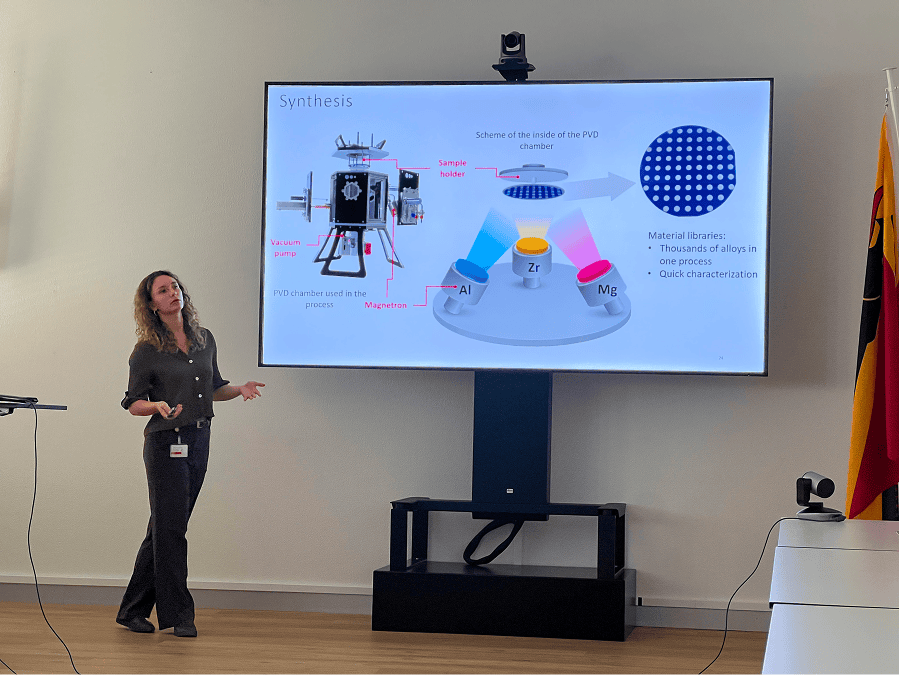
During her research stay at Empa Thun, RADISH team member Hanna Szebesczyk had the opportunity to present her work during a scientific seminar and discuss the latest results of her research with the Empa team.
While RADISH is focused on the accelerated discovery of materials for high-temperature applications, this talk took the audience in a very different, lightweight direction. Titled “Accelerated discovery of high-strength aluminum alloys: The Al–Mg–Zr system studied via high-throughput methods,” it presented a particularly promising Al–Mg–Zr study developed using the same philosophy of combinatorial materials science and high-throughput characterization that underpins our work in RADISH.
The approach creates a continuous composition gradient across a single wafer – effectively providing access to thousands of alloy compositions in one deposition experiment and enabling a large part of the Al–Mg–Zr compositional space to be explored in a fraction of the time required by conventional alloy development.
Hania walked through the three mechanisms behind the remarkable strength: solid-solution strengthening, grain refinement, and grain-boundary stabilization. Because the deposition process operates far from thermodynamic equilibrium, the films were expected to retain magnesium and zirconium in solid solution well beyond their equilibrium solubility limits. What we found, however, exceeded expectations – she discovered Al alloys with yield strengths of around 2 GPa.
The seminar closed with a look toward the next stage of the work: refining the synthesis strategy using HiPIMS and hybrid deposition approaches to further expand the accessible compositional and microstructural window.
A special thank you to Prof. Johann Michler for his hospitality and for giving us the opportunity to present and discuss this work at Empa. Many thanks also to Hendrik Jansen for coordinating the seminar and introducing the talk, and to the entire Empa team for the sharp questions, discussions, and valuable feedback.
These exchanges are exactly what makes high-throughput materials research so much fun – and often opens up completely new directions.