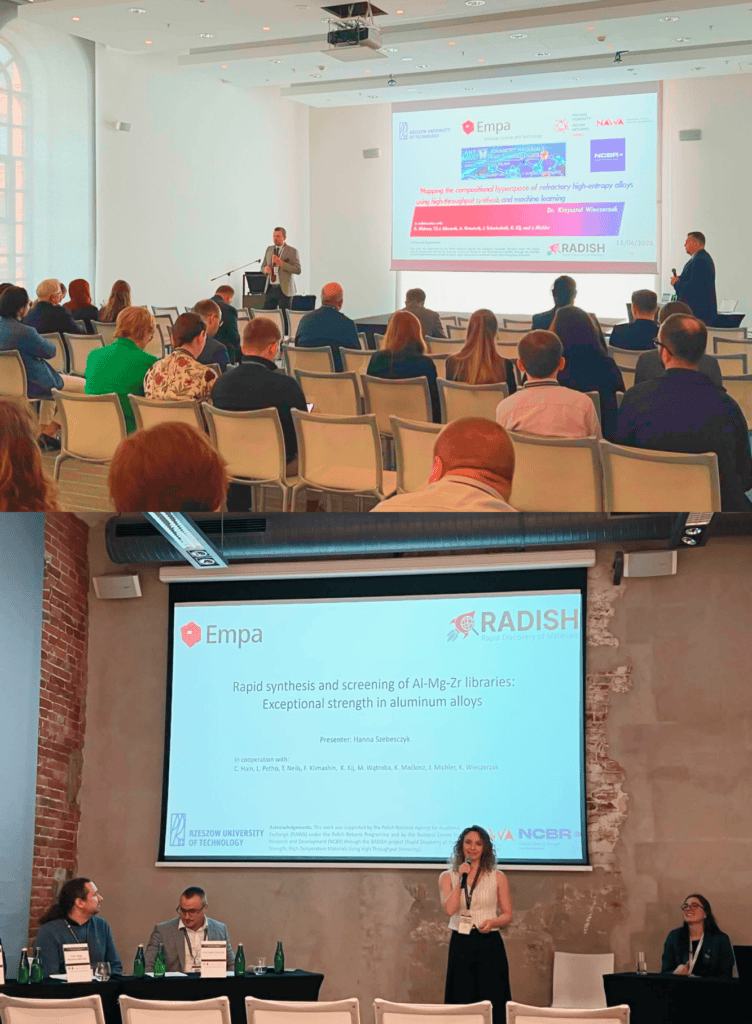
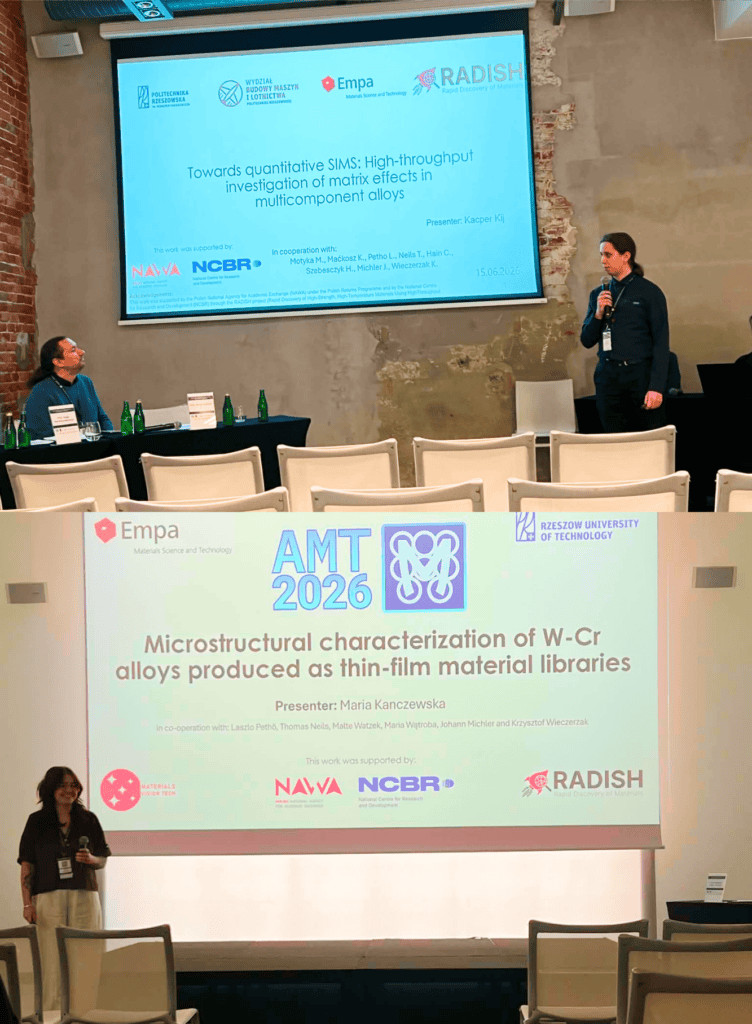
The RADISH team had the pleasure of participating in AMT 2026 – Advanced Materials and Technologies, an international conference that brought together researchers, industry representatives, and young scientists working in the field of materials engineering. The conference provided an excellent opportunity to present our latest research, exchange ideas with experts from different institutions, and discuss recent advances in advanced materials and high-throughput materials science.
We are proud that every member of our team contributed to the scientific programme by presenting their research. Krzysztof Wieczerzak delivered a presentation entitled „Mapping the Compositional Hyperspace of Refractory High-Entropy Alloys Using High-Throughput Synthesis and Machine Learning”, highlighting how high-throughput experiments combined with machine learning can accelerate the discovery of advanced high-temperature alloys. Maria Kanczewska presented „Effect of Deposition Temperature on the Microstructure of W-Cr Thin-Film Material Libraries”, focusing on the influence of processing conditions on the microstructure of tungsten-chromium thin films. Hanna Szebesczyk shared her work in „Rapid Synthesis and Screening of Al-Mg-Zr Libraries: Exceptional Strength in Aluminum Alloys”, demonstrating the potential of combinatorial methods for developing lightweight, high-strength aluminium alloys. Kacper Kij presented „Towards Quantitative SIMS: High-Throughput Investigation of Matrix Effects in Multicomponent Alloys”, addressing the challenges of quantitative secondary ion mass spectrometry analysis in complex alloy systems.
Beyond the presentations, AMT 2026 created an inspiring environment for scientific discussions and networking. It was a valuable opportunity to exchange knowledge, receive constructive feedback, and establish new collaborations with researchers from academia and industry. Conferences like AMT play an important role in strengthening the materials science community and fostering interdisciplinary research.
We would like to thank the organizers for hosting such a successful event and all participants for the engaging discussions. We are grateful for the opportunity to present the latest results of the RADISH project and look forward to future editions of the conference.